
Lessons from a Savings Bond by John Nowak, CFP®, CPA
Submitted by Moller Financial Services on July 9th, 2015In my home office, I have a bankers box that has financial documents that have accumulated over the last 20 years. The box includes tax returns from the 1990s, sales invoice and loan documents for my first car, and a savings bond purchased by my mother-in-law for my daughter. Like the service we provide to clients, I have scanned, saved, and organized the important financial information online. So this “clean-up” is an opportunity to review any new information and reminisce about the past.
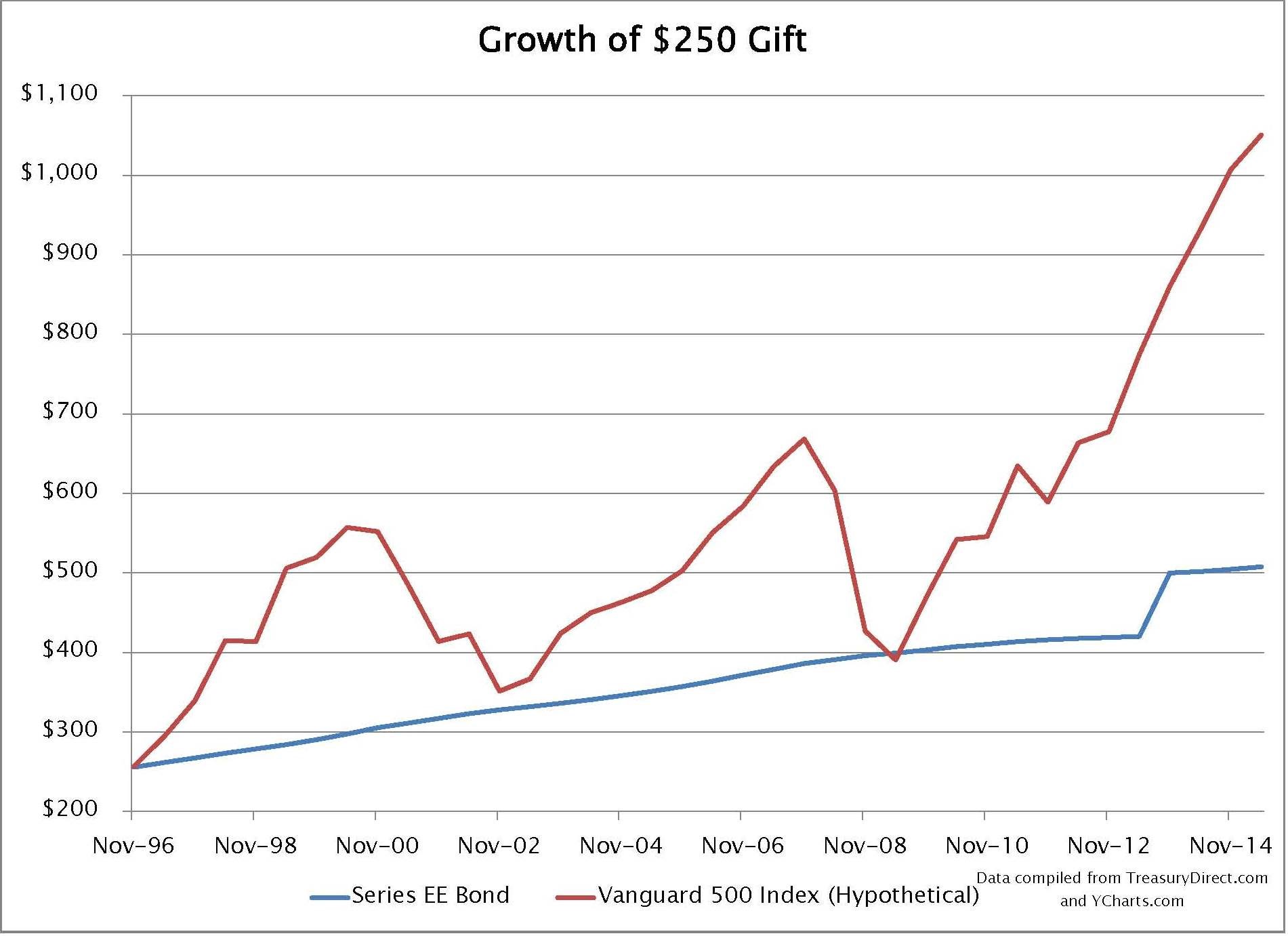
My mom recently reviewed her financial documents and found a savings bond for me. My aunt Dorothy purchased a $500 bond in 1996 that has been in my mom’s “safe” for almost 20 years! Since I don’t like having money unaccounted for, I immediately opened an account online at TreasuryDirect.gov, looked up the value of the bond, and transferred the paper bond to my online account. This bond was purchased in 1996 for $250 and is worth $507 today. While the current interest rate is 1.27%, the bond earned as much as 5.3% in 2000. Over the 19 year period, the bond’s annual return was 3.8%.
While this return is not great, it was a gift. Who can complain about that? Also, the savings bond she purchased in 1996 beat inflation by about 1.5%. Had I received $250 in 1996, it probably would have been spent on cheap beer and pizza. In my mind, the savings bond was a great gift and decent investment.
How does a U.S. Series EE Savings Bond purchased today fare? According to TreasuryDirect.gov, a savings bond today pays a fixed annual interest rate of 0.3% for the next 20 years! Will this bond have a chance of keeping up with inflation over the next two decades? I doubt it. Thank you Dorothy for buying this bond in 1996 and not 2015!
What If Stocks?
Now what if my aunt had purchased a low-cost stock index fund in 1996 instead of the U.S. savings bond? For example, $250 would have been enough to buy almost 4 shares of the Vanguard 500 Index in September 1996. How much would those 4 shares be worth today? Keep in mind that since 1996, the U.S. and world has experienced the following events:
- Asian financial crisis
- Internet bubble
- September 11th and other terrorist attacks
- Wars in Iraq and Afghanistan
- Global financial crisis
- Tax hike, tax cut, another tax hike
- Two recessions
- Two stock market declines of over 45%
Despite all these events, the Vanguard fund would be worth over $1,000 today, or twice the value of the savings bond purchased at the same time. However as shown in the comparison below, there would have been many ups and downs by owning the stock fund compared to the savings bond. Making it through these volatile periods is the price an investor pays for growing long-term wealth.
Lessons Learned
Owning bonds for the next 20 years, especially a U.S. savings bond with 0.3% interest, carries its own risk of losing purchasing power over time. While owning stocks can be volatile in the short-term, they are an important part of growing wealth and maintaining purchasing power in the long-term. For the financial plans that I oversee, there are a couple good uses of bonds:
- To pay for needs in the short-term that are too large to be paid from the “core” diversified portfolio. Additional healthcare costs incurred before Medicare is available or funds to replace and defer Social Security income are two examples of additional needs that are a great use for bonds.
- As a permanent or temporary allocation in the portfolio to reduce volatility.
Another lesson from this recently discovered bond is how nice it is to save. $250 that would have otherwise been spent in 1996 is now worth $500 or $1,000 today depending on how it was invested. Even a small amount saved in today’s dollars compounds over time.
Most importantly and whether you own stocks or bonds, it is imperative to have and follow a well-prepared, organized financial plan. Without a plan, the stocks and bonds you own are about as valuable as the baseball cards that sit next to my bankers box.
